Antiscalant for RO Plants and Industrial Water Treatment
What Is an Antiscalant? A Complete Guide to Scale Inhibitors in Water Treatment
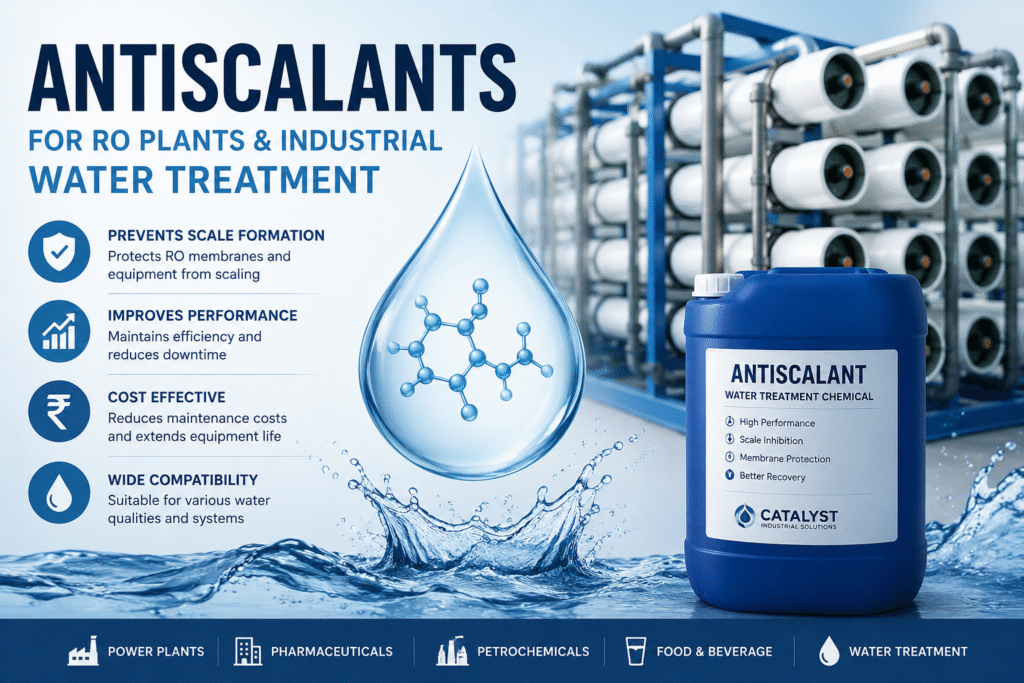
If you run a reverse osmosis (RO) system, a cooling tower, or a boiler, you’ve probably run into the word antiscalant somewhere along the way — usually right after a maintenance bill for a scaled-up membrane. So what exactly is this chemical, how does it work, and do you actually need it?
This guide breaks down everything you need to know about antiscalants: what they are, how they prevent scale at a molecular level, the main types available, how dosing works, and how to choose the right product for your water chemistry.
What Is an Antiscalant?
An antiscalant — also called a scale inhibitor — is a chemical additive dosed into feed water to stop dissolved minerals from crystallizing into hard scale deposits. The term is most associated with reverse osmosis and nanofiltration systems, but antiscalants are also used in cooling towers, boilers, pipelines, and oil and gas operations.
Scale forms when water contains more dissolved salt than it can hold in solution. As water passes through a membrane or heats up in a boiler, the leftover water becomes more concentrated, pushing minerals like calcium, magnesium, and silica past their solubility limit. Once that limit is crossed, the minerals stop staying dissolved and start crystallizing onto the nearest surface — usually a membrane, pipe wall, or heat exchanger.
Antiscalants don’t remove these minerals from the water. Instead, they interfere with the crystallization process itself, keeping the minerals suspended and mobile long enough to pass through the system and exit with the wastewater (called the concentrate or brine) before they ever get the chance to harden.
Why Scale Is a Problem in the First Place
Before diving deeper into how antiscalants work, it helps to understand exactly what they’re fighting.
The most common scale-forming compounds in industrial water systems include:
- Calcium carbonate (CaCO₃) — the most frequent scale culprit, especially in hard water
- Calcium sulfate (CaSO₄), often called gypsum scale
- Barium sulfate (BaSO₄) and strontium sulfate (SrSO₄) — common in oilfield and groundwater applications
- Silica (SiO₂) — notoriously difficult to control, especially at higher temperatures
When these compounds deposit on a membrane surface, they don’t just sit there harmlessly. Scale:
- Reduces permeate flow rate, forcing pumps to work harder
- Increases differential pressure across the system
- Lowers salt rejection, letting more dissolved solids through into your treated water
- Shortens membrane lifespan, since scale is difficult to fully reverse even with cleaning
- Drives up energy costs and unplanned downtime
In cooling towers and boilers, scale buildup acts as an insulating layer on heat exchange surfaces, cutting thermal efficiency and forcing systems to burn more fuel or electricity to hit the same temperature targets.
How Antiscalants Work: The Three Mechanisms
Antiscalants don’t use a single trick — they typically combine three different mechanisms to keep minerals from turning into scale.
1. Threshold inhibition Antiscalant molecules attach to tiny mineral clusters before they can grow into full crystals, effectively raising the concentration of dissolved salt the water can hold without precipitating. This lets water carry far more dissolved calcium, sulfate, or silica than it normally could.
2. Crystal modification Even when crystals do begin to form, antiscalants can distort their shape. Instead of growing into hard, sharp, interlocking crystals that bond tightly to a surface, the minerals form soft, irregular, non-adherent particles that don’t stick — they simply get carried along in the water flow.
3. Dispersion Most antiscalants carry a negative charge. Since many scale-forming particles also pick up a slight charge as they form, the antiscalant molecules repel each other and the particles, keeping everything spread out instead of clumping together into larger, stickier masses.
In practice, most commercial antiscalant products are formulated to use all three mechanisms simultaneously, tuned for whichever scale type is most likely to occur in your feed water.
The Main Types of Antiscalants
Not all antiscalants are built the same way. Choosing the right type comes down to your water chemistry — specifically, which minerals are present and at what concentration.
Phosphonate-based antiscalants
These are highly effective at low dosages, particularly against calcium carbonate scale. Phosphonate, acrylic polymer, and polycarboxylic acid-based antiscalants are among the most commonly tested scale inhibitor chemistries in membrane treatment research. Phosphonates are popular in municipal and light industrial RO systems where calcium carbonate is the dominant scaling risk. The tradeoff is that they introduce phosphorus into the discharge stream, which can matter where local environmental regulations cap phosphorus content in wastewater.
Polymeric antiscalants
Polymeric antiscalants (built from acrylic acid, maleic acid, or similar polymer backbones) tend to perform across a wider range of scale types, including silica and sulfate-based scales, making them a common choice for systems with mixed or unpredictable water chemistry. Commercially available antiscalants are broadly grouped into phosphates, phosphonates, and polycarboxylates. Polymeric products are generally phosphorus-free, which helps where discharge regulations are strict, but they sometimes require a higher dose to achieve the same inhibition as phosphonates.
Blended antiscalants
Blended formulations combine phosphonate and polymeric chemistries to get the best of both — strong threshold inhibition from the phosphonate component plus the wider scale coverage of the polymer. These are typically used in systems facing multiple scale risks at once, such as desalination plants treating water with high calcium, sulfate, and silica content simultaneously.
How Much Antiscalant Do You Actually Need?
Dosing is where a lot of antiscalant programs go wrong — too little and scale still forms; too much wastes money and can create other fouling issues.
Typical industrial dosing falls in the low parts-per-million (ppm) range, though the exact number depends heavily on the application:
- RO/desalination systems generally dose in the range of a few ppm, adjusted to feed water hardness, silica content, and target recovery rate
- Cooling tower systems often run higher, since water recirculates for much longer before being discharged — typical dosages for common phosphonates range between 3 to 5 ppm active in cooling tower recirculating water, while polymer-based products can require 8 to 12 ppm active in high-calcite-saturation conditions
A useful concept here is residence time. A once-through cooling system might only need a fraction of a ppm to inhibit calcium carbonate because water passes through in seconds, while a recirculating system holding water for 48 hours might need ten times that dose to achieve the same protection — because the minerals have far more time to concentrate and attempt to crystallize.
This means dosing isn’t just about water hardness; it’s also about how long the water sits in the system before it leaves, what temperature it reaches, and what recovery rate (the percentage of feed water converted to usable product water) the system is targeting.
What Factors Determine Which Antiscalant You Need?
There’s no universal antiscalant that works for every system. Selecting the right product means analyzing your feed water against a handful of variables:
- Water hardness and mineral profile — calcium, magnesium, sulfate, barium, strontium, and silica levels all push you toward different chemistries
- System recovery rate — higher recovery concentrates the reject stream further, increasing scaling risk and antiscalant demand
- Temperature — higher temperatures generally reduce solubility for some salts (and increase it for others), shifting which scale type dominates
- pH — strongly affects carbonate scale risk in particular, since pH controls the equilibrium between bicarbonate and carbonate ions
- Compatibility with other treatment chemicals — antiscalants must work alongside any biocides, coagulants, or pH adjusters already in the system
- Regulatory limits on discharge — phosphorus restrictions in your region may rule out phosphonate-based products
Most antiscalant suppliers offer software tools or lab analysis services that model your specific feed water and recommend a product and dosage rate, since getting this wrong either leaves the system unprotected or wastes chemical (and money) on overdosing.
Antiscalant vs. Water Softening: What’s the Difference?
It’s worth clearing up a common point of confusion. Water softening (typically via ion exchange) physically removes hardness minerals like calcium and magnesium from water before it enters a system. Antiscalants take a different approach — they leave the minerals in the water but prevent them from crystallizing.
Softening is more thorough but adds cost, requires regular resin regeneration, and isn’t always practical for large industrial flow rates. Antiscalant dosing is cheaper to implement and works continuously with minimal infrastructure, but it has limits — it delays scale formation rather than eliminating the minerals outright, so at very high concentration factors, even a well-dosed antiscalant program can be overwhelmed.
Many industrial systems use both: light softening or pH adjustment as pretreatment, with antiscalant dosing as a continuous safeguard against whatever hardness remains.
Common Applications of Antiscalants
Antiscalants show up across a wide range of industries wherever water concentration and mineral precipitation are a risk:
- Municipal and industrial RO/desalination plants — protecting membranes processing brackish or seawater feed
- Cooling towers and condensers — preventing heat-exchange surface fouling that reduces thermal efficiency
- Boilers — guarding against scale on internal heating surfaces
- Oil and gas production — preventing scale in downhole equipment, pipelines, and surface processing facilities, where barium and strontium sulfate scales are a particular concern
- Mining operations — protecting process water systems from scale buildup that reduces flow rates and damages equipment
Frequently Asked Questions
Is antiscalant safe? Most commercial antiscalants are formulated to be safe for the intended application and are widely used in municipal drinking water treatment. As with any water treatment chemical, dosing should follow manufacturer guidelines and any local regulatory requirements, particularly around discharge limits.
How long does antiscalant last in a system? Antiscalant isn’t a one-time treatment — it’s continuously dosed into feed water as part of ongoing pretreatment, since it only protects the water currently passing through the system.
Can you use too much antiscalant? Yes. Overdosing wastes chemical and money, and in some cases can contribute to its own fouling issues on membrane surfaces. Dosing should be based on actual feed water analysis, not guesswork.
Does antiscalant remove existing scale? No. Antiscalants are preventive — they stop new scale from forming. Removing existing scale requires a separate membrane cleaning process using appropriate cleaning chemicals.
Final Thoughts
Antiscalants are a small input with an outsized impact on system uptime. By interfering with crystallization through threshold inhibition, crystal modification, and dispersion, they let RO membranes, cooling towers, and boilers run far longer between cleanings — protecting both equipment and operating budgets. Getting the most out of an antiscalant program comes down to understanding your specific feed water chemistry and matching it to the right chemistry, dose, and pretreatment strategy.
If you’re setting up or troubleshooting a water treatment system, getting your feed water tested before selecting an antiscalant will save far more in avoided downtime than it costs upfront.